

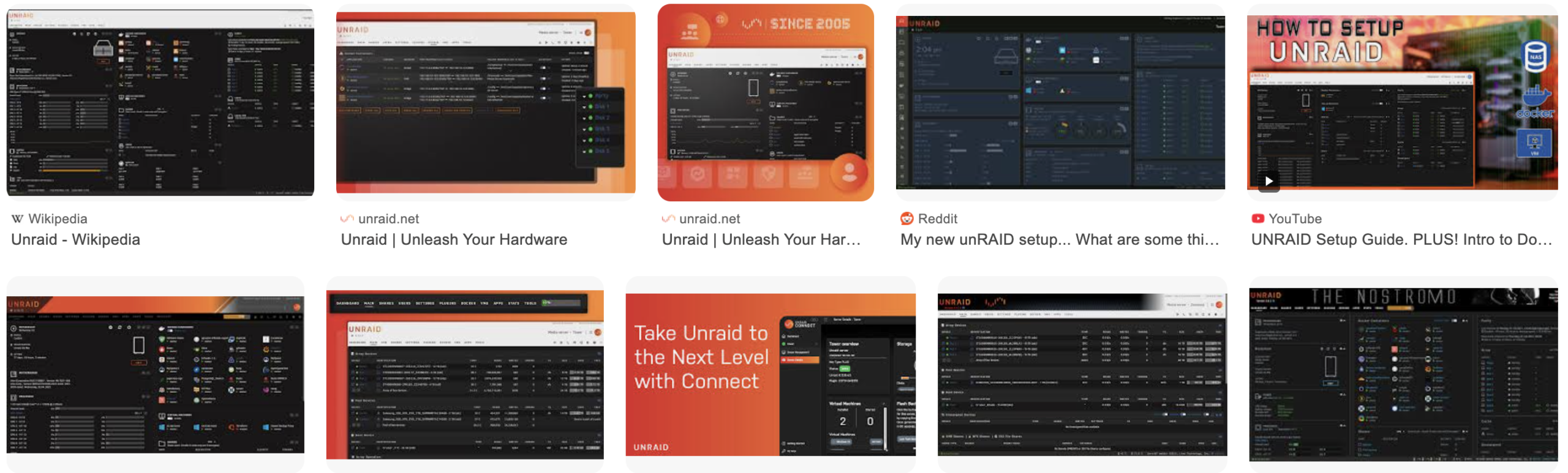
Overview & Analysis
Unraid is a lightweight operating system designed for building personal servers, combining network-attached storage (NAS), application hosting, and virtualization into one platform. It allows users to securely store data, run Docker applications, and manage virtual machines—all from a user-friendly web interface.
Unlike traditional RAID systems, Unraid offers flexible storage by allowing users to mix different drive sizes and expand capacity over time without rebuilding the system. This makes it a popular choice for home servers, media storage, and self-hosted applications.
Key Features
Flexible Storage Array
Combine different hard drives and expand storage without rebuilding your system.
Parity Protection
Protect data with one or two parity drives, allowing recovery if a disk fails.
Docker Application Support
Run thousands of apps via Docker containers with easy installation and isolation.
Virtual Machine Hosting
Run Windows, Linux, or other OS with near-native performance using virtualization.
Web-based Management (WebGUI)
Manage storage, apps, and system settings through an intuitive browser interface.
Cache Drive Acceleration
Use cache drives to significantly improve write speed and system performance.
✅ Pros
- Flexible storage with mixed drive sizes
- Easy expansion without rebuilding arrays
- User-friendly web interface
- Supports Docker applications
- Built-in virtual machine support
- Hardware-agnostic (runs on most systems)
- Strong data protection with parity drives
- All-in-one NAS + server + virtualization
❌ Cons
- Not free (requires license)
- Initial setup can be complex for beginners
- Performance depends on hardware
- Not a traditional RAID system
- Limited enterprise features compared to enterprise NAS
- Requires dedicated machine/server